


Most charging networks are generating activity. But they are not capturing their full revenue potential.
A typical fast charging station operating at 10–15% utilization – a figure consistent with what we observe across our network globally, leaving a significant portion of its potential revenue unrealized. In many cases, this translates into tens of thousands of dollars in lost annual revenue per station.
The system works. It just does not work efficiently enough.
The proof is already in the field.
One of GO TO-U’s partners operated a high-traffic location with multiple fast chargers already installed. Before implementing demand management, the pattern was typical for the market: uneven usage, peak-hour congestion, lost sessions due to queues, and average monthly energy consumption of 8,000–10,000 kWh.
After introducing reservation-based demand orchestration:
- In the first month alone, consumption rose to 13,000 kWh – despite charging at a higher tariff than competing stations at the same location
- Within a few months, usage reached 19,000 kWh
- After expansion, the site exceeded 29,000 kWh per month. And this is just the beginning.
Meanwhile, competing chargers at the same location saw utilization drop by approximately 53%.
The difference was not hardware. It was not location. It was the ability to structure and control demand.
The Hidden Cost of an Unstructured System
The core issue is not demand. EV adoption is growing, traffic is increasing, and the need for charging is real.
The problem is that demand is not structured.
This is not a temporary inefficiency. It is a limitation of the model itself.
Why the Traditional Approach Stops Scaling
The industry has long operated under a simple assumption: if you build more stations, demand will distribute itself over time.
In practice, this does not happen.
Demand concentrates into predictable peak hours, leaving large portions of the day underutilized. Expanding infrastructure does not solve the problem – it simply scales inefficiency. This is why many operators see network growth without corresponding growth in performance.
The Utilization Ceiling No One Talks About
Across the market, a consistent pattern emerges. Average utilization sits around 10–15%. In strong locations, it may reach 20–24%.
At around 25%, the system begins to break under its own demand. Peak hours become congested, queues form, and potential sessions are lost.
Demand exists. But it cannot be captured.
This is not a demand problem. It is a control problem.
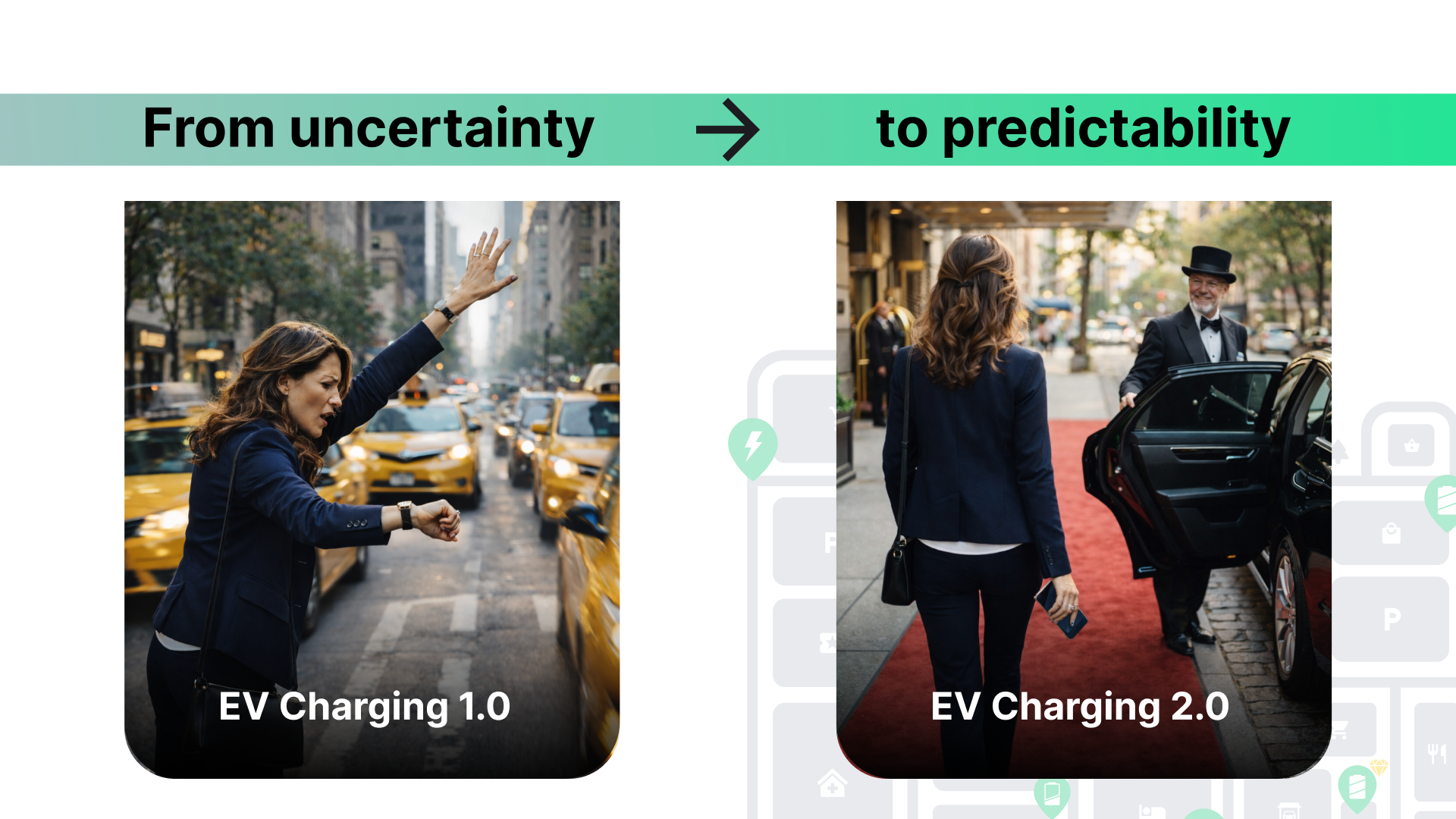
EV Charging 1.0: A Model That Cannot Scale
Most of the market still operates on a simple principle: first come, first served.
Drivers arrive without certainty. Access depends on timing, not planning. The system reacts to demand but does not manage it. Reactive systems do not scale efficiently.
For years, the industry has focused on availability – is the station online, is it visible on the map, does it show as available? But availability does not guarantee a session. A station can appear available and still fail to deliver charging when the driver arrives.
The real question is not whether the station exists. It is whether it will be available at the exact moment it is needed.
EV Charging 2.0: From Access to Control
A new model is emerging – one built on predictability.
As Nazar Davyda, CEO and Co-Founder of GO TO-U, explains: “Most charging networks today still operate like early taxi services – first come, first served. But no system scales on randomness. Uber changed that model. You do not search for a car anymore. You book it and know it will arrive. The same shift is happening in EV charging. Reservation is not an additional feature. It is the foundation of a predictable service.”
In most existing solutions, reservation is implemented as a simple time block that does not change how the system operates. In the new model, reservation defines the system itself. Demand is distributed across time, congestion is reduced, and utilization increases without adding new infrastructure.
The system moves from reactive to controlled.
What Changes in the Business Model
When demand becomes structured, the economics fundamentally shift.
Without demand control: peak-hour congestion limits throughput, off-peak hours remain underutilized, revenue depends on unpredictable spikes, and drivers lose trust and churn.
With structured demand: charging sessions are distributed throughout the day, utilization increases across all time periods, revenue becomes stable and predictable, and drivers return because the experience is reliable.
The difference is not incremental. It is structural.
Where the Real Growth Opportunity Exists
Most operators continue to look for growth in expansion — more stations, more locations, more power.
But the largest opportunity already exists within their current network. In idle hours. In missed sessions. In unmanaged demand.
Growth is no longer about how much infrastructure you deploy. It is about how effectively you use what you already have.
Conclusion: The Future Is Built on Control
The future of EV charging will not be defined by how many stations are installed. It will be defined by how effectively they are used.
The operators who learn to structure demand will outperform those who continue to react to it. Because when demand is controlled, growth becomes predictable and predictable systems are the ones that scale.
Ready to see how much revenue your current network is leaving on the table? Let's talk to our team contact@goto-u.com