


A 30-unit residential community brought 20 existing EV chargers back online, solved recurring breaker trips, and created a predictable charging experience for residents without replacing its charging infrastructure.
Key Results
|
Challenge |
Result with GO TO-U |
|
Previous vendor transition stalled for three months |
GO TO-U brought the chargers online in one day |
|
20 chargers affected by connectivity and configuration issues |
Existing hardware was connected and managed through GO TO-U |
|
$20,000+ potential electrical upgrade |
Costly rewiring was avoided |
|
Repeated breaker trips and resident complaints |
Reservation-based scheduling eliminated breaker-related calls |
|
Manual troubleshooting for the board |
Proactive monitoring and support from GO TO-U |
The Situation
When Joel first helped bring EV charging to his Toluca Lake condominium in 2022, the building had only a few electric vehicle drivers.
At the time, charging seemed like a forward-looking amenity. It was useful, modern, and aligned with where residents were clearly headed. Joel, who serves on the condominium board, saw EV charging as an important long-term contribution to the building.
Then adoption accelerated.
Within a few years, 16 to 18 households in the 30-unit community were driving electric vehicles. Charging was no longer a nice-to-have. It had become essential residential infrastructure.
But the charging system installed for the building had not been designed for that level of demand.
What followed is a situation many condominium boards and multifamily properties are beginning to recognize: the chargers were physically there, but the system around them was not strong enough to support real daily use.
The Problem: EV Charging Had Become Too Expensive and Too Unreliable
The first warning sign was pricing.
With only a few weeks’ notice, the previous provider increased the charging rate by 20 cents per kilowatt-hour. For residents who depended on the building’s chargers, the increase was sudden and significant.
“Last year, with just a few weeks’ notice they changed their rate and increased it by 20 cents per kilowatt. That was a huge jump, all of a sudden, for our drivers and our owners. So we needed to make a change.” Joel, Condominium Board Member
Joel decided to switch providers. On paper, the decision was simple: residents needed a better charging experience, and the building needed a more reliable operating model.
In reality, the transition became more complicated than expected.
When the first provider disconnected its system, the process created new technical problems. According to Joel, cables running throughout the parking structure were cut instead of being cleanly unwired. Those cables then had to be stripped, re-terminated, and adjusted because the lengths no longer lined up properly.
Then another issue appeared. The SIM card trays had been removed from the chargers, leaving Wi-Fi as the only connectivity option. That forced Joel to think not only about charging, but also about how to make connectivity work across the entire parking area.
The next vendor promised to resolve the situation. But the missing SIM trays became a blocker, and the transition stalled.
For three months, the building had installed chargers, growing resident demand, and no reliable way to operate the system.
“That other company promised they’d take care of us. When we tried to make the transition, we found out our chargers were lacking the tray for the SIM card. Trying to solve that took three months. Unbelievable.” Joel
For a condominium board, this kind of problem is not just technical. It becomes personal very quickly.
Residents need to charge. They send emails. They call. They expect answers. And the board member responsible for the project becomes the person everyone turns to when the system does not work.
The GO TO-U Intervention
Joel was introduced to GO TO-U through a trusted contact who believed the team could solve the problem. By that point, the building did not need another promise. It needed someone to take ownership.
GO TO-U stepped in, reviewed the existing setup, worked with the chargers already installed, and brought the system online in one day.
What had taken the previous vendor three months was resolved by GO TO-U in a single day.
“From three months to one day. One day. And not only did they take care of us, they honored what I had with those companies, and on top of that, they did better. I felt like the cavalry had just shown up to rescue me.” Joel
The speed mattered. But the more important difference was the approach.
GO TO-U did not treat the building as a standard charger migration. The team looked at the real infrastructure, the real wiring limitations, the existing hardware, the resident demand, and the operational pressure on the board.
That is where the real problem became visible.
The Hidden Issue: The Electrical Setup Could Not Support Real EV Demand
Once the chargers were back online, the building faced a deeper issue inherited from the original installation.
The condominium had 20 chargers, each rated at 32 amps. But the chargers had been wired in clusters of four per breaker, and each breaker was rated for only 40 amps.
The system could not support multiple vehicles charging at the same time within the same cluster.
When the building had only two EVs, the issue was easy to miss. But with 16 EVs now using the chargers, the limitation became unavoidable.
If more than one driver tried to charge in the same cluster, the breaker would trip.
That meant offline chargers, frustrated residents, emails, phone calls, and manual intervention. Sometimes Joel had to go downstairs and reset breakers himself. If he was away, he had to ask someone else to help.
An electrician confirmed that solving the issue through a conventional electrical upgrade would cost more than $20,000.
For a 30-unit condominium, that would likely mean a special assessment. In other words, every owner could be asked to pay for an infrastructure problem they did not create.
“To solve it electrically would have been over $20,000. A massive cost, a special assessment, owners upset, because it wasn’t done right the first time. That wasn’t us; it was the company that cut corners and didn’t think ahead.” Joel
This is one of the most important lessons for other condos: EV charging problems are often not caused by the charger itself. They come from how charging sessions are managed against limited electrical capacity.
Installing chargers is only the beginning. Managing demand is where the real value starts.
The Solution: Use Reservations to Manage Capacity Instead of Rewiring the Building
GO TO-U did not start by recommending a costly electrical upgrade.
Instead, the team came on site, walked the property with Joel, reviewed the electrical panel, and worked through the real charging constraints. The solution was not to force the building to spend more money on infrastructure. The solution was to make the existing infrastructure work intelligently.
GO TO-U configured the charging experience around scheduled reservations.
Instead of allowing multiple vehicles to compete for the same limited electrical capacity at the same time, the system now organizes charging by time window. Each cluster allows one vehicle to charge at a time. The next resident can reserve the following available slot, plug in, and let the session start automatically when the previous session ends.
Same chargers.
Same breakers.
No expensive rewiring.
“One of the things that sets GO TO-U apart is that you can reserve when you want to charge. I get home at 8 p.m., someone’s charging until 11. I schedule mine to start at 11. I hook it up, go home, don’t worry about a thing. As soon as the other car is done, mine kicks in automatically.” Joel
This is where GO TO-U’s Advanced Reservation Technology becomes much more than a convenience feature. For condos and multifamily properties, reservations are a practical operating tool. They help control demand, prevent conflicts, reduce infrastructure stress, and make charging predictable for residents.
In this case, the reservation system turned an electrical limitation into a manageable schedule.
The Outcome: No More Breaker Calls, No Costly Upgrade, More Peace of Mind
The impact was immediate.
Before GO TO-U, the building was dealing with repeated breaker trips and resident complaints. Joel was the person receiving the calls and emails when something went wrong.
After the reservation-based charging schedule was implemented, that stopped.
“Since we implemented the reservation option, there are no more emails, no more calls. I can sleep well at night.” Joel
The financial impact was clear: the building avoided a $20,000+ electrical upgrade.
But for Joel, the value went beyond the money.
“It saved me headaches. It gave me years back in my life, because now I can sleep. The money’s great, but really, it’s peace of mind. That’s what I get with GO TO-U.” Joel
For a condominium board, that peace of mind matters.
A charging system should not create a second job for the person responsible for it. It should work in the background, serve residents reliably, and give the board confidence that the infrastructure can support growing EV adoption.
That is what changed with GO TO-U.
A Better Experience for Residents
The solution also had to work for residents.
Joel, who was a first-time charger user himself, found the GO TO-U mobile app simple and intuitive. The process felt so easy that he double-checked whether he had done everything correctly.
That simplicity is essential in a residential environment. Residents do not want to understand charger configuration, breaker limits, or electrical load. They want to reserve a time, plug in, and know their vehicle will charge.
GO TO-U made that experience possible.
The support model also changed. Instead of waiting for residents to report problems, GO TO-U proactively monitors the chargers. If a charger goes offline, the team can identify the issue, notify Joel, and help resolve it.
“Other companies set you up and say good luck, let us know if something breaks. With GO TO-U I feel like I’m part of the family, like they’re looking out for me. Every time I see the team show up, I’m seeing a cousin, a brother. That’s a huge difference.” Joel
For Joel, this was the difference between a vendor and a partner.
Why This Case Matters for Other Condos
Many condominium boards are facing the same transition.
A few residents buy EVs. Then a few more. Soon, the building realizes that EV charging is no longer an optional amenity. It is part of the property’s core infrastructure.
But most buildings were not originally designed for high EV charging demand.
That creates three common problems:
- Limited electrical capacity
The building may not be able to support every driver charging whenever they want. - Unpredictable resident demand
Without scheduling, residents compete for access, creating frustration and operational pressure. - Expensive upgrade decisions
Boards are often told that the only solution is more electrical work, more hardware, or more capital expense.
This case shows another path.
With GO TO-U, the Toluca Lake condominium did not need to replace its chargers or immediately rewire the building. It needed an intelligent operating system that could manage charging sessions around real capacity.
That is the difference between basic EV charging management and EV Charging 2.0.
Joel’s Advice to Other Properties
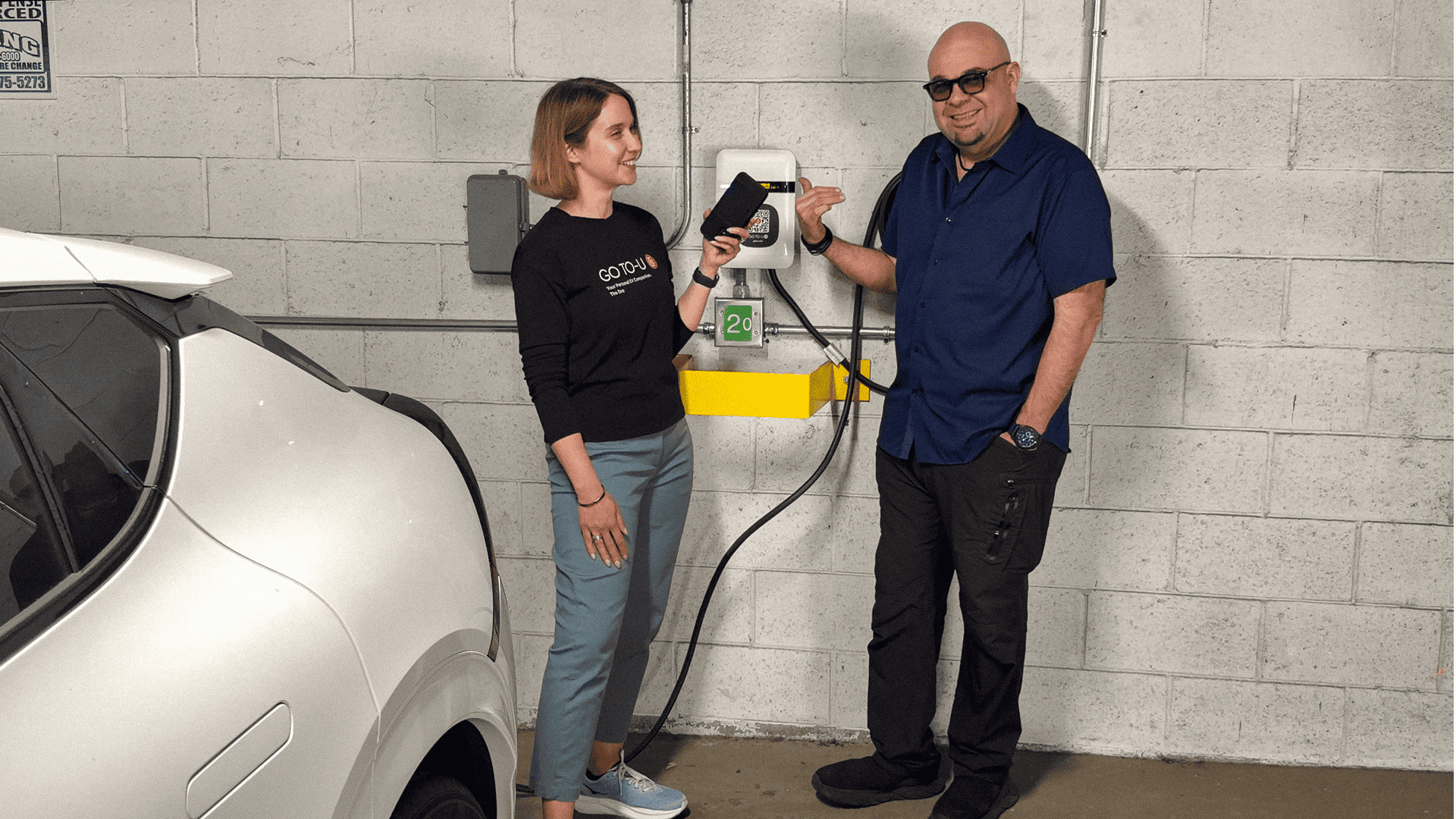
Check the interview conducted on site by Lyubov and Lena Artemenko, co-founders of GO TO-U, asking what he would tell another condominium board, HOA, or property manager facing similar EV charging challenges, Joel is direct.
“Don’t waste your time with any other company. Go straight to GO TO-U. It’s about having a partner in the EV-charging experience, not just someone providing a service. You’ll sleep a lot better.” Joel